from Four American Indian Preludes
Louis W. Ballard (1931–2007)
About the Composer
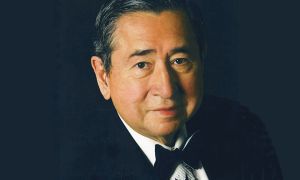
Louis W. Ballard (1931-2007) was a Quapaw and Cherokee composer, educator, and advocate whose work helped establish an important place for Indigenous voices within American concert music. Born on the Quapaw Reservation near Quapaw, Oklahoma, Ballard was given the Quapaw name Honganozhe, meaning “Stands with Eagles.” He studied piano in his youth and went on to earn degrees in music education and fine arts as well as a master’s degree in music, studying at the University of Oklahoma and the University of Tulsa.
Ballard’s career brought his work as a composer into close relationship with his commitment to Indigenous arts and education. From the founding of the Institute of American Indian Arts in Santa Fe in 1962 until 1970, he served as its director of music and performing arts. He subsequently became director of music curricula for the Bureau of Indian Affairs school system, giving him a national role in music education for Indigenous students. His compositions drew upon both his Western classical training and Indigenous musical and cultural traditions, creating a musical language in which those influences could meet on his own terms.
Ballard composed across a wide range of genres, including orchestral, chamber, piano, choral, and theatrical works. Among his best-known compositions are Four Moons (1967), a ballet created for Oklahoma’s sixtieth anniversary of statehood, and Incident at Wounded Knee (1974), a large-scale work responding both to the 1890 massacre at Wounded Knee and to events there in 1973. His achievements were recognized with a Lifetime Musical Achievement Award from First Americans in the Arts in 1997 and induction into the Oklahoma Music Hall of Fame in 2004, where he became the first classical composer to receive that honor.
About the Piece
Louis W. Ballard composed his Four American Indian Piano Preludes in 1963 while studying with Darius Milhaud at the Aspen Music School. The four short works draw upon musical and cultural traditions familiar to Ballard from his Quapaw upbringing while also reflecting his extensive training in twentieth-century composition. Nekátohe (“Love Song”), the third prelude, was dedicated to Ballard’s second wife, Ruth Doré.
Ballard conceived Nekátohe as a dialogue between two voices: the left hand representing the male and the right hand the female. He described this counterpoint as echoing the “polarity of life” and the interaction between the two. The writing evokes the courtship-song traditions of Native peoples of the Plains, musical traditions with which Ballard had direct experience through his participation in Quapaw cultural life.
The result is an intimate piece in which the idea of a love song is expressed not through a single lyrical melody with accompaniment, but through relationship. The two lines remain distinct yet continually respond to one another, weaving together across a wide dynamic range to create a musical conversation whose meaning lies in their interaction. Nekátohe offers a particularly concentrated example of Ballard’s ability to bring his Indigenous cultural knowledge and contemporary compositional language together within the concert-piano tradition.
Explore Further
- Louis W Ballard memorial website (maintained by family)
- Louis W Ballard (Oklahoma Historical Society)
- Female Rain: Indigenous American Piano Music (pianist Roberta Rust’s 2026 album featuring works by Ballard and Connor Chee)
Sheet Music
Four American Indian Piano Preludes was published by New Southwest Music Publications. Copies are held by a number of university and research libraries and may be available through interlibrary loan. If you are interested in performing the work, I recommend searching your local or university library catalog or consulting WorldCat to locate a copy.

