Bright Sheng (b. 1955)
About the Composer
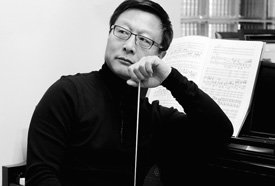
Bright Sheng is a Chinese-American composer, conductor, and pianist whose music frequently brings Chinese and Western musical traditions into dialogue. Born in Shanghai in 1955, he began studying piano with his mother at age four. During China’s Cultural Revolution, Sheng was sent at age fifteen to Qinghai, a province bordering Tibet, where he spent seven years performing as a pianist and percussionist with the provincial music and dance theater while studying and collecting the folk music of the region.
When China’s universities reopened in 1978, Sheng was among the first students admitted to the Shanghai Conservatory of Music, where he studied composition. He moved to the United States in 1982, earning graduate degrees from Queens College and Columbia University. His teachers included George Perle, Hugo Weisgall, Chou Wen-Chung, Jack Beeson, and Mario Davidovsky. At Tanglewood in 1985 he met Leonard Bernstein, who became an important mentor; Sheng subsequently studied composition and conducting with Bernstein and worked as his assistant until Bernstein’s death in 1990.
Sheng’s orchestral, chamber, vocal, and theatrical works have been commissioned and performed by major ensembles throughout North America, Europe, and Asia. In 2001 he received a MacArthur Fellowship, and since 1995 he has taught composition at the University of Michigan, where he is the Leonard Bernstein Distinguished University Professor of Music. Throughout his career, Sheng has drawn upon the musical traditions of both China and the West, creating a musical language shaped by his experience in—and deep engagement with—both cultures.
About the Piece
Bright Sheng composed My Song (M’ai Sang) in 1989 as a four-movement work for solo piano, dedicating it to pianist Peter Serkin. Across the four movements, Sheng draws upon Chinese folk traditions in different ways, from folk-song material and dance to compositional techniques derived from Chinese musical practice. The opening movement, heard here, serves as a prelude to the larger work.
Sheng describes this first movement as having a “folklore style,” constructed through the development of heterophony, a texture he identifies as characteristic of Asian music. The movement is highly polyrhythmic, with multiple strands of related melodic material unfolding simultaneously at different rhythmic rates. Beneath them lies a resonance that is present throughout the piece: at the opening, the pianist silently depresses a cluster of pitches in the deep bass and holds them with the sostenuto pedal, allowing those strings to resonate sympathetically with pitches played in the higher registers.
The result is lyrical and contemplative, but also quietly exploratory. Rather than quoting a specific folk song, Sheng draws upon a way of organizing and developing melody, allowing the music’s connection to Chinese tradition to emerge through its construction rather than through direct quotation. At the very end, the pianist reaches inside the instrument to strike specific bass strings directly with a finger, bringing the movement to a close with the resonant sound of the piano itself.
Explore Further
- Bright Sheng (official website)
- Bright Sheng: cross-cultural emissary (interview with the composer)
Sheet Music
The score for My Song (M’ai Sang) is available from the publisher. The linked page also includes audio clips from Peter Serkin’s recording of all four movements.

